
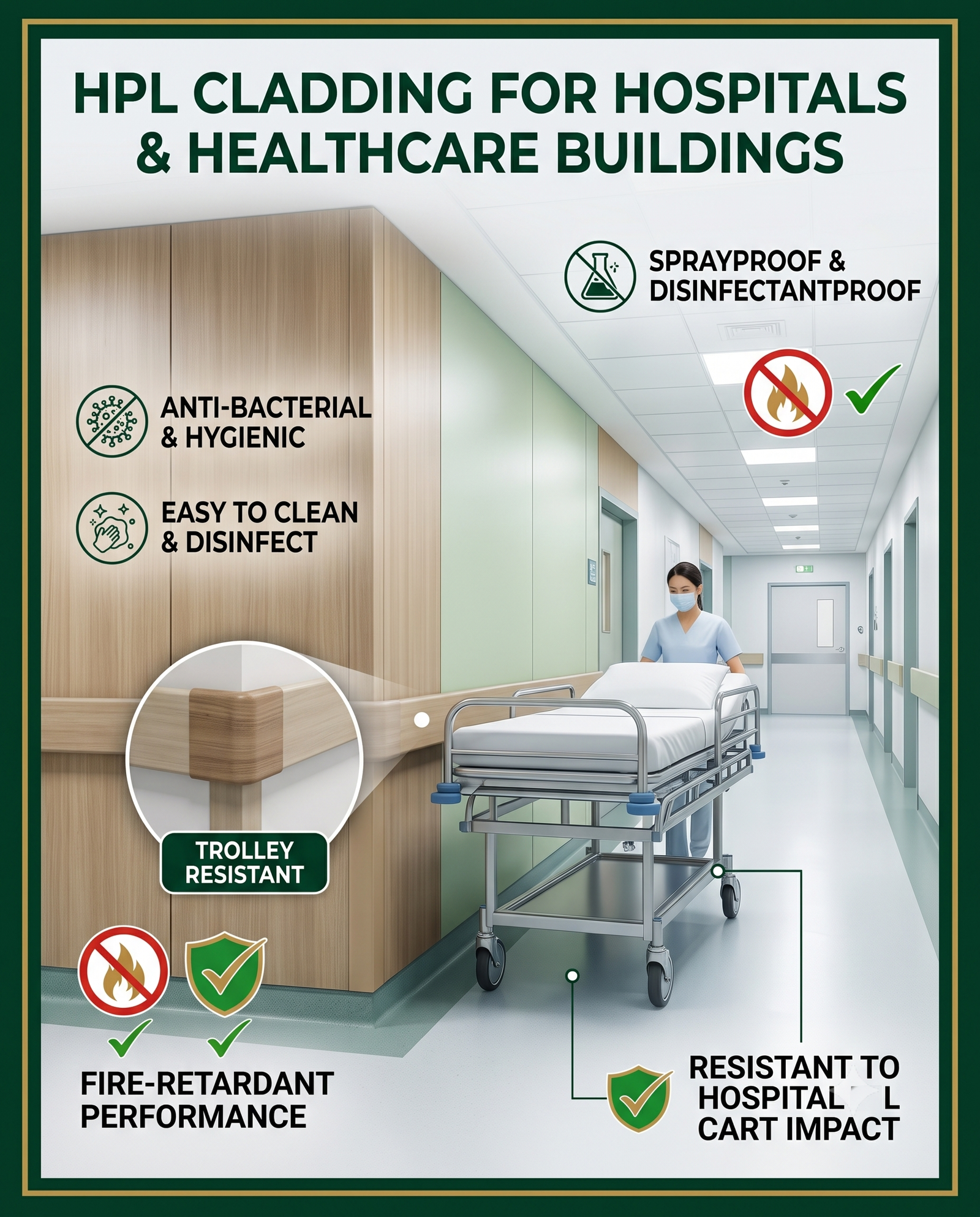
Quick answer: HPL suits healthcare buildings because its non-porous surface tolerates repeated disinfection, resists trolley and bed impact, does not swell in wet areas, and is available in fire retardant grades. It is used on facades, corridor dado panels, wet room linings, cubicles and furniture surfaces.
Table of Contents
- What Healthcare Buildings Demand From a Surface
- Where HPL Is Used in a Hospital
- Hygiene: What HPL Does and Does Not Claim
- Fire Safety in Healthcare
- Design Considerations That Improve Patient Experience
- Frequently Asked Questions
What Healthcare Buildings Demand From a Surface
- Cleanability – surfaces are disinfected repeatedly, often with strong agents, several times a day.
- Non-porosity – a surface that absorbs moisture is a surface that can harbour contamination.
- Impact resistance – trolleys, beds, wheelchairs and equipment collide with walls constantly.
- Fire performance – evacuation is slow or impossible in many hospital areas, so material fire behaviour is scrutinised closely.
- Continuity of operation – a material that needs repainting means wards out of service, which is a real clinical cost.
- Appearance – patient experience research consistently links environment quality to perceived care quality.
Where HPL Is Used in a Hospital
| Location | Application | Recommended approach |
|---|---|---|
| External facade | Ventilated rainscreen cladding | Exterior grade, fire retardant, 6-8mm |
| Corridors | Dado and full-height wall protection | 6mm on sub-frame, impact zones prioritised |
| Wards and rooms | Headwall panels, wall linings | Laminate on substrate, matt finish |
| Toilets and wet rooms | Cubicles, IPS ducts, wall linings | 12mm compact laminate |
| Furniture | Nurse stations, counters, storage | Compact or laminate on substrate |
| Lift lobbies | Column and wall cladding | 6mm, darker shades at contact height |
Hygiene: What HPL Does and Does Not Claim
It is important to be precise here rather than to overclaim. HPL is a non-porous, dense laminate with a closed surface, which means it does not absorb moisture and can be cleaned and disinfected thoroughly without degrading. That is a meaningful hygiene property and it is the reason healthcare specifiers favour it over porous or coated alternatives.
Some laminates are additionally produced with antimicrobial surface treatments. Where a project requires that, ask for the specific product and its test data – it should never be assumed as a default property of all HPL. What every good exterior or compact HPL does offer is a surface that stays cleanable for its whole life instead of becoming porous as a coating wears through.
Fire Safety in Healthcare
Hospitals sit at the strict end of fire regulation because occupants may be immobile, anaesthetised or dependent on equipment. That has three practical consequences for cladding specification.
- Specify a tested fire retardant grade and obtain the laboratory report for the exact product code and thickness.
- Treat the facade as an assembly – cavity barriers, non-combustible insulation and metal sub-framing all form part of the fire strategy.
- Involve the fire consultant before ordering, not at inspection stage, so approvals are aligned with what is actually being supplied.
Design Considerations That Improve Patient Experience
- Warm wood decors substantially soften clinical spaces without introducing a material that cannot be cleaned.
- Use colour zoning by department or floor to aid wayfinding – a genuine functional benefit in large hospitals.
- Matt finishes reduce glare, which matters for patients lying on their backs under bright lighting.
- Coved and sealed junctions at wet areas make cleaning faster and more thorough.
- Keep darker tones at trolley height where scuffing is inevitable, lighter tones above.
Key Takeaways
- HPL’s non-porous surface tolerates repeated disinfection without degrading.
- It resists the trolley and bed impact that destroys painted and coated wall finishes.
- Fire retardant grade with documented test data is essential in healthcare buildings.
- 12mm compact laminate suits wet rooms, cubicles and IPS ducts.
- Warm decors and colour zoning improve both patient experience and wayfinding.
Frequently Asked Questions
Is HPL suitable for hospitals?
Yes. Its non-porous, cleanable surface, impact resistance and availability in fire retardant grades make it a common specification for healthcare facades, corridors, wet areas, cubicles and furniture.
Is HPL antibacterial?
Standard HPL is non-porous and cleanable, which supports hygiene, but that is not the same as an antimicrobial surface treatment. If a project requires antimicrobial performance, ask for that specific product and its supporting test data rather than assuming it.
What grade of HPL should a hospital use?
Exterior grade for facades and 12mm compact for wet areas and cubicles, in both cases with a tested fire retardant classification appropriate to the building’s fire strategy.
Can HPL withstand hospital disinfectants?
HPL tolerates routine disinfection well. Very aggressive chemicals and abrasive cleaning should still be avoided, and the manufacturer’s care guidance should be issued to the housekeeping team to keep the warranty valid.
Does cladding a hospital facade disrupt operations?
A ventilated rainscreen is installed from outside on brackets, so internal disruption is minimal compared with internal wall works. It also removes the recurring repaint cycle that takes areas out of service every few years.
Related Reading on HPL Maker
Talk to HPL Maker
HPL Maker is an Indian manufacturer of exterior-grade high pressure laminate with an industry-first live camera warranty of up to 25 years. Share your drawings or elevation photos and our team will suggest the right shade, thickness and fixing system for your project.
- Call / WhatsApp: +91 89824 90236
- Email: marketing@hplmaker.com
- Factory & Head Office: 124-126, Vrindavan Palace, Nipania Main Road, Vijay Nagar, Indore – 452010, Madhya Pradesh, India